
Blog
My Art, My Perspective
Categories

Painting Glasgow
I’ve recently been spending more time exploring Glasgow’s Merchant City, sketchbook and iPhone in hand, looking for things that catch my eye and might eventually make their way into a painting. I’ve always liked this part of Glasgow, but there’s something about slowing down and really looking at a place that makes you notice far more than you do when you’re simply passing through.
For me, it’s rarely just about finding a pretty view. I’m looking at the shapes of the buildings, the way the light falls across the stone, interesting windows and doorways, people moving through the streets and, quite often, a combination of old and new that I think will translate well onto canvas. I take far more photographs than I’ll ever paint, but I like having that visual record to go back to when I’m back in the studio.
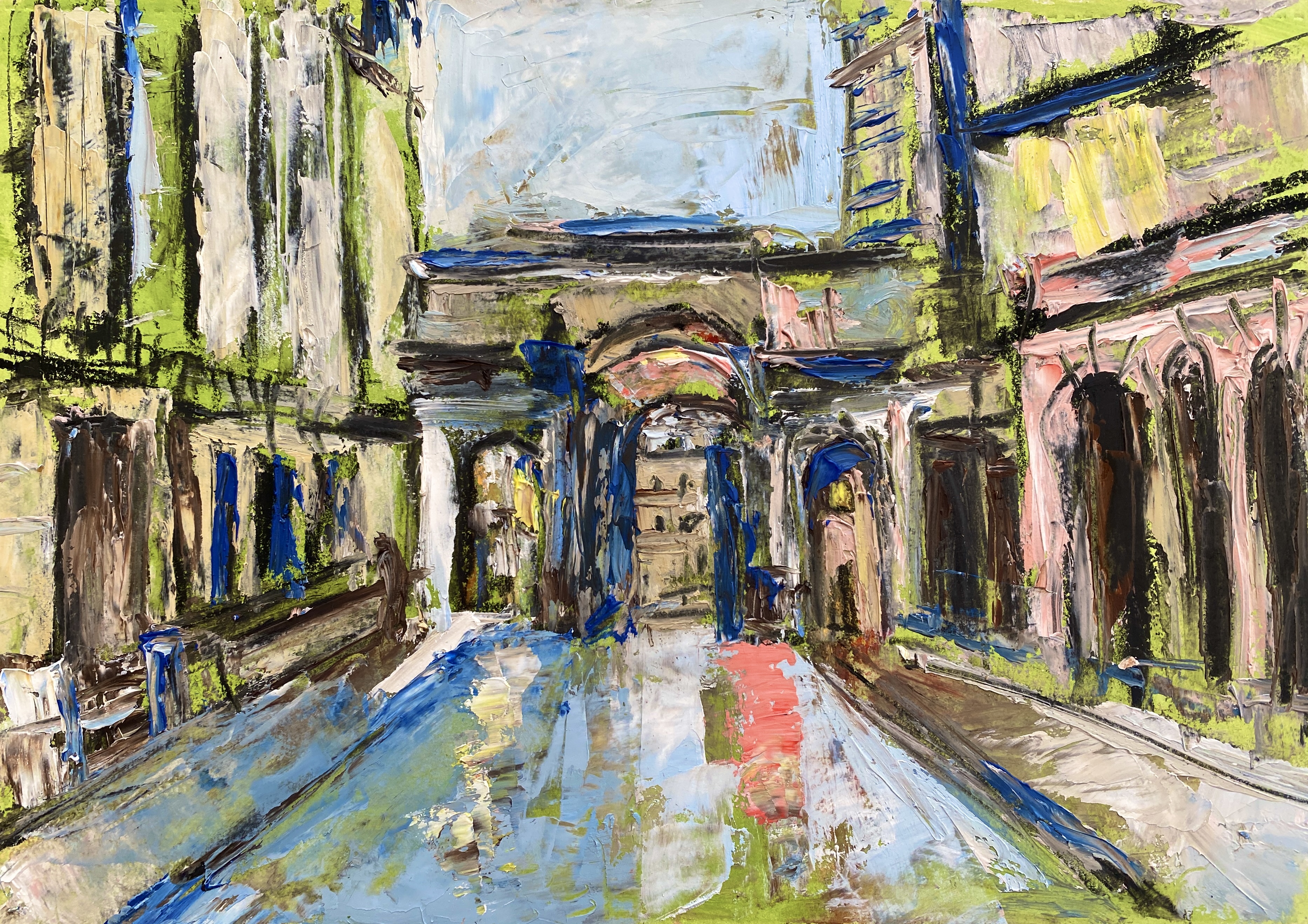
Royal Exchange Square
One of the places I keep coming back to is Royal Exchange Square. It has exactly the sort of mix that I enjoy painting — impressive historic architecture, people sitting outside cafés, pedestrians crossing the square and all the everyday activity that stops it from feeling like a static architectural study.
The Gallery of Modern Art sits right in the middle of it, in a building with a history that is almost as interesting as the building itself. It was originally built in the late 1700s as the home of wealthy Glasgow merchant William Cunninghame. It later became the Royal Exchange and has had a surprisingly varied life, including time as a bank, library and telephone exchange, before becoming the Gallery of Modern Art in 1996.
I love finding out things like this about the places I paint. It changes the way I look at them. A building that might initially catch my attention because of its shape, colour or proportions suddenly has another layer to it once you know what has happened there over the years.
And that’s often what makes me want to paint somewhere. I’m not necessarily trying to create a perfect record of the building. I’m more interested in capturing what it feels like to be there now, while some of that history is still visible in the architecture around me.
Merchant City
There’s a lot of history packed into Merchant City. The area grew as Glasgow became an important centre of trade, and many of the grand buildings we see today reflect the wealth created by the city’s merchants and its international trading connections.
That history is complicated, though, and it’s important not to gloss over the darker side of Glasgow’s wealth. The city’s trading prosperity was closely connected to the transatlantic slave trade and to goods produced through enslaved labour. Glasgow Museums now acknowledges these connections, including those linked to the buildings around Royal Exchange Square.
I think it’s important to recognise that history when talking about this part of Glasgow. The architecture is impressive, but the story behind it isn’t always as straightforward as the buildings might suggest. From an artist’s point of view, I’m particularly drawn to the contrast between the historic architecture and the Merchant City as it is today. Old stone buildings sit alongside contemporary shops, cafés and restaurants, and I love the way these different layers of the city come together. I don’t necessarily want my paintings to feel too still or overly precise. I’m interested in the shapes, colours, textures and changing light, and in creating a composition that leads your eye around the painting. Even when there isn’t a person or car in sight, I want there to be a sense of life and energy in the way the painting is put together.
Painting Glasgow
The way I paint Glasgow is probably just as important as what I choose to paint. My mark making is bold, bright and deliberately expressive, and I think that suits Glasgow rather well. One of my favourite artists is Joan Eardley, and I’ve always loved her Glasgow paintings. What really draws me to her work is the expressive feeling she managed to give them. Her paintings aren’t simply records of the places and people she saw; you can feel something of the atmosphere and character of Glasgow in the way she painted. That’s something I really respond to, and it’s made me think about how I want to approach my own Glasgow paintings.
I’m not trying to reproduce every architectural detail or make the buildings look perfectly neat. Instead, I use strong marks, blocks of colour and a fairly loose approach to capture the character of the place. I want the paintings to have energy and movement, just as the city does.
Glasgow has such a distinctive combination of grandeur and grit. You can have beautiful Victorian architecture covered in years of weather and wear, a brightly painted shopfront beside an old stone building, and people rushing through the middle of it all. It’s those contrasts that I find interesting and that give me plenty to work with as a painter.
I love working with bright colour against Glasgow’s often muted stone buildings. The colour brings out details that might otherwise disappear, while my palette knife and loose brushstrokes add texture and movement to the paintings. I like the marks to remain visible rather than smoothing everything away — they give the work a sense of energy and keep it feeling spontaneous, even though I usually spend a lot of time thinking about the composition before I start painting.
There’s something about Glasgow that really lends itself to this way of painting. The architecture, changing light, busy streets and layers of history give me plenty to respond to, and I enjoy interpreting rather than simply reproducing what I see.
For me, that’s what I’m trying to capture when I paint Glasgow — its charm, but also its grit; its beautiful architecture, but also the everyday life happening around it. I want the paintings to feel like Glasgow rather than simply look like Glasgow.

